 |
||
|
||

Home > TERATEC FORUM >Workshops
 |
The essential meeting place for all digital players Simulation . HPC/HPDA . Artificial Intelligence . Quantum Computing |
Workshop 05 - 9:00 am to 11:00 am |
Chaired by Paco Chinesta, Professeur des universités, ENSAM and Dominique Baillargeat, Scientific executive director, CNRS&CREATE
|
The session was structured to cover three areas:
- The city
- The region
- A roundtable discussion on achievements, initiatives, and barriers to implementation
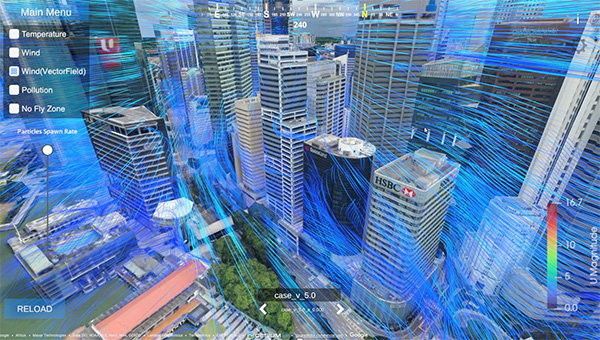
At the city level, Bouygues presented its strategy covering buildings, neighborhoods, and the city within its environment and the needs of its residents. The environment (thermal comfort, air quality, etc.) was addressed by the ARIA/SUEZ and Duoverse partnership, which successfully built a digital environmental twin of the city of Singapore as part of the DesCartes project being developed by the CNRS through its subsidiary CNRS@CREATE. The predictions are currently being validated as part of a collaboration between CNRS@CREATE and HTX (the agency of Singapore’s Ministry of Home Affairs). Finally, a connected city cannot exist without an adequate communication system. Keysight presented the context of future communications in smart cities, emphasizing in particular the challenges to be addressed—from future IoT technologies all the way to 6G.
The BRGM subsequently addressed the spatial dimension and subsurface modeling, with the main challenges being inverse problems, under-observation, and the intrinsic variability inherent in the subsurface. It was emphasized that the creation of comprehensive digital twins—covering the atmosphere, surface, and subsurface—would require collaboration among various communities to build a modeling platform that combines knowledge (engineering science models) with data processed by AI-driven tools.
During the roundtable discussion, representatives from the cities of Angers and Brussels shared their success stories regarding the use of digital twins in crisis response and preparedness in urban management. The PEPR CRISES initiative was also presented, with a particular focus on its goals and challenges for improving urban management. Finally, in conclusion, the political and societal dimensions were addressed to understand the barriers to widespread implementation of these high-potential solutions. Suggestions for moving forward were put forward.
|

Jean-Pascal JEGU
Tel : +33 (0)9 70 65 02 10
jean-pascal.jegu@teratec.fr
Campus TERATEC
2, rue de la Piquetterie
91680 BRUYERES-LE-CHATEL
France